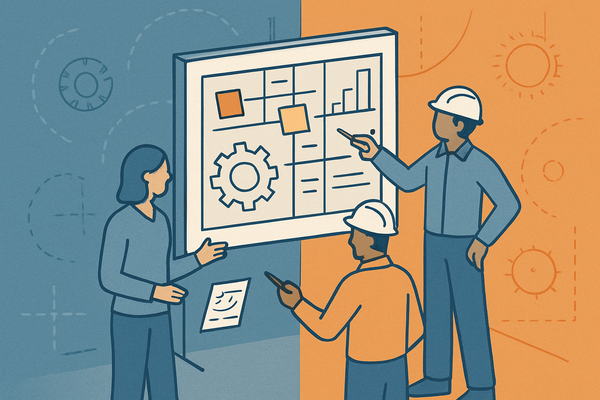
Short answer: App development project management is shipping software in small validated slices — not one big-bang launch. For most app teams: agile with light Scrum wins, discovery comes before development, estimate stories in points (1-2-3-5-8) not hours, and only count delivered user value toward velocity. Tools matter less than people think — the bottleneck is almost always ceremony, not software. Under five people on the team? Skip hiring a PM. You don't need one; you need a PM-shaped engineer who runs a tighter standup.
App development project management involves taking an app from idea to shipped product while preventing the budget, team, and inbox from going up in flames. Basically, it’s risk management with some extra meetings and most of the meetings are optional. This concludes the article. You may cease reading. Alternatively, you can carry on and discover which meetings you are able to skip.
I’m glad to see you still here (most of them are easy ones).
This project management is for engineers, anchors, and founders who’ve landed project management on their laps without inheriting the training, and would broadly prefer to write code. In this article, we will explore what app development project management actually is and how to choose a methodology that fits the app team (most don’t). We will also see how the phase of a typical app project lays out in reality, and the two opinions. Those separate teams who ship from teams who plan. We will also look at situations when you shouldn’t consider hiring a project manager, as that conversation no one is having.
The book cites examples and references from two decades of software product development within the Pivotal/Tanzu Labs practice that supports the building of LiteTracker. All of it is practical. Everything has been done before; you learn from the instances in which things were done badly.
App development project management, plainly explained
The app development project management refers to overseeing the journey of an app from idea to launch or release. So, it should not cost much, demoralise the team or ship something nobody wants. All done. Three Error Modalities, One Discipline
In reality, it is just a few things, in roughly this order.
- Deciding what to build first — and what to not build first, which is harder.
- Breaking work into pieces small enough to actually finish — usually called stories or features, never "epics that span three quarters".
- Estimating those pieces so the team can forecast a date with a straight face.
- Running just enough ceremony — standup, planning, retro — to keep humans aligned without grinding the work itself to a halt.
- Catching the meta-problem early — scope creep, broken velocity, lost focus — before it eats six weeks of runway.
.
Certainly, the widely accepted definition of project management is making a Gantt chart, and then watching the Gantt chart be wrong. It does happen from time to time. However, that is project management theatre. Using the case study of the app team “Jungle”, the authors show a lean agile project management approach that combines classic Agile with Lean Startup. The resulting blueprint is not the objective, but the product.
App development differs specifically from "project management" in the abstract for one reason: the unit of value is shippable software. Do not make it about, a deliverable PDF, a milestone, a status update. We can say, “users can” or “users can’t”. That's the only signal that's important. Each process, tool, or methodology choice should be appraised against only one question: what is the benefit of this? Does this somehow make the loop shorter between the idea and the user being able to use it?
If Not, Just Let It Go We'll frequently revisit this topic.
Pick a methodology before you pick a tool

One of the most common mistakes made on a new app project is selecting Jira before the methodology Jira is designed to support. The tool is not the choice. The selection is a selection.
There are four methodologies that pop up in the SERP, and you should be honest about your fit for an app team.
Incremental creative process able to accommodate change. Go-to choice for app development. Applications are permanently responding to feedback, App Store reviews, OS updates, and also the founder’s brain-wave at 11pm A linear strategy cannot withstand that. Agile is a structure that prevents us from pretending we can plan a year ahead. The Agile Manifesto serves as the canonical reference, consisting of four brief principles that remain accurate today, despite being written in 2001.
Scrum is an Agile approach that adds structure by defining Sprints, Daily Standups and the Sprint Planning and Review arms. It helps app teams only if you remember it’s a scaffolding, not a religion. Many teams are unsuccessful using Scrum because all ceremonies are merely deployed to the letter. They forget that the ceremonies exist to serve the work, not the opposite. The official Scrum Guide is here read it once, then run it like an engineer, not like clergy.
Watrfall. Everything planned up front, executed sequentially. This is applicable in projects where requirements are stable and there is no feedback loop from users. For e.g. compliance projects, hardware which is tied to fixed-date launch. Apps don't benefit from design or UX-as-usual. The reason is very straightforward. Apps live and die on what users do when they touch them. And users only get to touch them after release. The Waterfall structure is incapable of utilizing that signal.
Kanban follows a pull-based flow with WIP limits and does not use fixed iterations. Excellent choice for support teams and ongoing maintenance work. When developing a new app, there is no rhythm, forced retrospection, or checkpoint. As a result, the team doesn’t ask itself whether it is still the right thing to be building. Kanban is to be used for a feature-flowing application and not before it goes live.
Most app teams are recommended to begin with agile and light Scrum. (Standup, two-week iterations, retro). Eliminate ceremonies when they cease to provide value for money. If only three people are present, don't conduct a sprint review; they are all already in the daily stand-up.
LiteTracker implements an iteration, velocity, and accepted stories system; it’s XP-flavoured agile, not true Scrum. We have opinions about why tooling should simplify, not add complexity; they’re load-bearing.
Discovery first, or you'll build the wrong thing
The biggest cost on a failed app project is seldom the developers. It’s the months of engineering aimed at the wrong target. Finding the target before code is written is called Discovery.
A genuine discovery phase with an app delivers three things.
- A clear definition of "win" in business terms. Not "increase engagement." A measurable number with a deadline — e.g. 15% Day-30 retention by month 4. Without this, every feature decision becomes a vibe.
- User personas built from real research. Not "tech-savvy millennials". Specific, named, with goals — "Alex, casual listener, wants a playlist for the train, won't open the app more than twice a week". Personas are the lens you hold up to every feature request.
- A Product Requirements Document (PRD) — the constitution. The thing you point at when someone wants to slip a "quick" social-sharing feature into iteration two. The PRD won't stop scope creep, but it will make every scope-creep conversation explicit instead of accidental.
The initial story carries the highest risk of being incorrect. There is no single correct answer, though there are incorrect. The default mistake is starting with “User can sign in”. Signing in alone doesn’t add value as there’s nothing to sign into yet! Focus instead on something that puts real value in a real user’s hands and validates the riskiest assumption. For an e-commerce minimum viable product, it might be one page that lists the product of the week with a phone number. This tests whether there is enough demand for someone to buy, even before any login, cart, or payment code gets written.
A senior product manager I collaborated with referred to discovery as “the cheapest place to fail.” She was right. Every wrong assumption uncovered in a workshop costs a whiteboard. Every false assumption that gets discovered in production will cost you an iteration.
Advocate for the necessity of discovering before building if pressured to skip. Two weeks discovery will cost you exactly the cost of two weeks. If skipping a retrospective has no cost, it will be what the first wrong build costs you, which is always months and almost always more than two weeks.
The five phases of an app project

A well-scoped MVP is estimated to range close to 22-31 weeks from concept to polished launch, based on agency benchmarks. The figure.
| Phase | Duration | What happens |
|---|---|---|
| Discovery & Planning | 2–3 weeks | Personas, PRD, riskiest-assumption identification, success metric |
| Design & Architecture | 4–6 weeks | UX flows, key screens, technical architecture, service boundaries |
| Core Development | 12–16 weeks | The actual build — iterations, story acceptance, vertical slices |
| Testing & Refinement | 4–6 weeks | QA cycles, beta, performance tuning, app store prep |
| Launch & Post-launch | Ongoing | Submission, monitoring, fixes, iteration 1.1 |
A few points to consider.
Design doesn’t ‘stop’ before development starts, these phases overlap, they don’t sequence cleanly. The discovery phase doesn't end after week 3. Real-world application projects have a fuzzy (not well-defined) front-loading activity of strategy, and a fuzzy back-loading activity of polish, with most of the team in development most of the time. The boxes are a helpful fiction.
The core development work is organized in iterations of 2 weeks (6 to 8 total) and not in phases. Every output has the potential to ship, that is a vertical slice of a working feature that an anchor accepts. If you are unable to identify a piece of user-visible value that has come into existence in the aftermath of an iteration, that iteration has failed, and the ensuing retro will turn out to be the most crucial meeting of the week.
After the launch is not a “phase”. It’s the remainder of a product’s life. Simply consider the delivery as the original document and not the last. The statistic on mobile usage it’s projected that in 2026 about 62.5% of global internet traffic will come from mobile is a way of saying: most of your users will arrive after launch, not before. Prepare for that.
When core development takes longer than expected, “we’ll just shorten the QA phase” is the universal cop out. The biggest risk to schedule is when testing and refinement get compressed. Refrain From It. The buffer exists since there will always be an unforeseen buffer of bugs that you did not know about. Either launch later or launch less.
Estimate in points, not time
Evidence spanning decades suggests engineers struggle with time estimates but perform reasonably well with relative sizing. Humans can answer the question which is harder this or that. We should accept that the honest answer to “how many hours will this take?” is: I don’t know. It’s software.
The workings.
- Use a Fibonacci-style point scale: 1, 2, 3, 5, 8. Five buckets is enough. Anything finer pretends to a precision that isn't there. No 13s. No half-points. The discipline is in the constraint. The argument against hourly estimates for user stories is the same argument here: humans are bad at hours and reasonable at relative size.
- Estimate features only. Bugs and chores don't get points — they're not new value, they're recovering lost ground or supporting infrastructure. Pointing them inflates velocity and turns it into a fiction.
- Track a rolling 3-iteration average. That's the team's velocity. It's a forecast, not a target. The moment a manager treats it as a target, the team games it, and you lose your forecasting tool.
- Use velocity to forecast, not to grade. "We have 80 points of work and a velocity of 18 — we're 4–5 iterations out" is a useful sentence. "Velocity dropped this week, what's going on?" is a worse sentence, and asking it weekly is how you break the practice.
This works because velocity is self-correcting. When the team keeps overcommitting, the average goes down, forecasts get more honest. The feedback loop is absent for time estimates; the team keeps repeating a guess every week without getting better at guessing.
It's not a matter of taste. This opinion is a substantial one. This is the main takeaway from this article, remember this.
Check out the deeper guide on choosing the best slice for your story, which elaborates on the splitting and estimation rules. You will find more instances there.
The story, not the ticket, is the unit of work

A story describes a piece of value delivered to the user through the product. This is not a engineering task. Not yet a Jira ticket. A tale. The Pivotal Labs principles of story writing lay out the user-facing test directly.
Can you explain what is done by explaining what a user can now do that they could not do before? A story will be there. If a description can only be made with code or component terms, it is an engineering task dressed as a story.
Authentication procedure. A child’s eye view is a single big story is a naive version.
A user can sign in, and sign out, and recover their password, and change their password, and recover their username.
That tale is too grand. Any story title that has one or more “and” is a location to split it. When done right, it becomes five separate, independently shippable, independently valuable stories.
- A user can sign in
- A user can sign out
- A user can recover their password
- A user can change their password
- A user can recover their username
Each one provided real value by themselves. One can accept each one of them independently. Each story registers on the burn-down chart upon completion, rather than a single large story lingering at 80% for three iterations.
As a rule, shorten the story. If the shorter version still delivers value, the original was massive. You haven't shrunk it too small if the shorter version delivers value.
This seems apparent. The majority of teams do not take this action. Tickets, which are units of engineering work, assigned by most teams are not based on user value but rather code modules. Which statement do you think you will remember in three months? “Build the password-reset endpoint.” Or "a user who forgot his password can get back in”? Which one would the PM likely care about? Which one will the user spot? The same response, three times.
Tickets are not bad. Engineering innovation units are referred to as “engines”. They simply aren’t the unit of progress. The two are different.
Tools matter, less than people think

The absence of tools mentioned up until now is intentional. Choosing a tool comes after choosing methodology. Use the right methodology and most tools will work.
That being said, here’s the 2026 landscape.
| Tool | Strength | Pain point for app teams |
|---|---|---|
| Jira | Configurability, enterprise scale | Heavy ceremony, every team customises until nobody recognises it |
| Linear | Speed, opinionated UX | Less mature for non-engineering roles |
| Trello | Onboarding is instant, free tier generous | Lightweight to the point of not enforcing methodology |
| Shortcut (ex-Clubhouse) | Clean story/epic model | Smaller ecosystem |
| LiteTracker | Velocity, accepted stories, XP-flavoured by design | Opinionated — won't bend to non-agile workflows |
| GitHub Projects | Free, lives with your code | Best as a complement, not a primary PM tool |
The harsh reality is that it’s the second most important decision after your methodology and even then a long second. Teams you respect shipped great work on a tool you’d find rough, while teams you don’t can have Jira configured to perfection and still ship nothing. The tool is not the constraint. The bottleneck is the ceremony. Not enough staff members. The real bottleneck is whether the PM can decide what to do next.
Choose a tool that embeds the methodology selected and don’t optimise. If you are utilizing XP-style iteration and relying on velocity-based forecasting, then select a tool that acts as a standard or enforcer. This is LiteTracker’s pitch full disclosure, we built LiteTracker. Jira is a good fit if you’re doing heavy scrum with multi-team dependants. An informal group of a few engineers in a Discord can get by with a simple Trello board and a calendar reminder for standup, for example.
When project management fails — three signs

The majority of unsuccessful app projects do not collapse. The discipline of something is breaking down when you see these three early signs.
This is when a new feature get added to your iteration and you can’t point to who decided on it. The product requirements document (PRD) is open in a tab somewhere and no one's looked at it in six weeks. Modify the PRD into every backlog grooming session and force every new feature to answer “does this directly benefit us hit the success metric?”. If it’s unclear, place it in the icebox.
The gaming of velocity is on the rise. That is, stories are getting smaller, and the velocity number is going up. Bugs and chores are discreetly receiving points to enhance the chart’s appearance. In 1:1’s, the PM is probing into “why’s the velocity dropping?” Stop debating velocity as a goal — velocity is not the goal. Talk about accepted stories as the goal instead. Velocity is a forecasting metric that should be used in planning and ignored elsewhere.
The work is consumed by the ceremony. Team spends more time describing work than doing it. The standup stretches on for 30 minutes, planning runs for 4 hours, retro became a complaint session, and a new “alignment sync” is on the calendar nobody asked for. Try eliminating one ceremony at each retrospective until the team feels progress has resumed. You will not be arrested for referring to the Scrum Guide. (It doesn’t, technically, arrest anyone.)
The underlying factor causing all three issues is the same: the process is running ahead of the work. The remedy is always the same: shrink the process until the work shows again.
When NOT to hire a project manager

If you have a team of engineers, conventional app dev advice tells you to get a PM. Do not. The cost of hiring is ultimately the most expensive spent, and a project manager on the wrong-sized team is overhead, not leverage.
A project manager is for all project.
- The team is under five people. Four engineers and a founder can run their own standup. A dedicated PM on a five-person team is hiring someone to manage four people's calendars, which is itself a job nobody asked for.
- There's only one product. The value of a PM is largely in inter-team coordination and roadmap multiplexing. With one product and one team, the founder or anchor can hold the roadmap in their head.
- The team already has someone PM-shaped. Often an engineer is doing it informally — running standup, writing the stories, talking to users. Promote them, give them the authority, and don't add a layer.
When you probably do need a PM.
- The team is over eight people on one product.
- You're running two or more products with a shared backlog.
- The founder is no longer the bottleneck — execution is, and a PM can unblock it.
- You need someone to own which problem is next, not just how the current problem gets done.
As Project Management Tool, We Say This. If your team is only four, and we’d have to sell you a $99/month plan, and a part-time PM, don’t bother. Create a free Trello board, conduct your own stand-up meeting, and reach out to us when there is genuine friction.
The highness of the authority of Scrum and Agile often makes us give up our commonsense with respect to development process.
Frequently asked

What is project management in app development?
The practice of delivering an application from idea to a functional product while not overspend, demotivating the team, or building something users do not want. It involves making decisions that include breaking down tasks into stories that are small enough to finish, making estimates, and running just enough ceremony to keep the team aligned without stopping the work.
What's the best project management methodology for app development?
Most application teams typically follow Agile with light Scrum as a standard. Eliminate any ceremony that doesn’t pay for itself; use two-week iterations, standup, planning, and retro. Waterfall is not an ideal methodology for app development as it fails to allow for a user feedback loop before release.
How long does it take to develop a mobile app?
A realistic time frame for a well-scoped MVP is 22 to 31 weeks, or roughly 3 to 9 months depending on complexity, platform, and team size. Enterprise apps have a life span of 12 or more months.
Why estimate in points and not hours?
For decades, engineers have demonstrated poor capabilities in time estimation and familiar in relative sizing. Points allow for forecasting based on observed velocity, which continuously self-corrects over 3 iterations. Time estimates are just guesses, repeated over and over every week with no give.
Should I count bugs and chores in velocity?
No. Bugs are not new tasks; they are repackaged old stories. Supporting infrastructure that provides no user value is chores. Both point out aggravates the speed turning it into fiction. Count solely accepted features.
Do I need a project manager for a small app project?
Likely Not. If there are less than five people on the team, you hire someone to manage the calendars of four engineers. Give authority to the PM-shaped engineer instead of appointing an XP Lead.
Agile vs Scrum — what's the actual difference for app development?
Agile refers to a set of principles such as iteration and feedback. Scrum focuses on outcomes, not outputs. The key differentiator is the backlog. It's possible to do agile without scrum. Scrum is only viable with agile principles.
How do you handle scope creep on an app project?
Every new feature must answer “does this directly help us hit the success metric defined in discovery?” If the answer, then that feature goes to the icebox until it is. We should regard the PRD as the constitution. Whenever there’s a new feature, pull this open and consult.
Still stuck
As soon as the methodology choice is sorted out, discovery is done, and the team is in an iterative mode of shipping most of project management value is already captured. Selection of tools represents the final 10%.
LiteTracker is the tool you want if you prefer to only get to velocity based forecasting, accepted-stories-only, and strict points-not-hours practice. You can use the free offer without being compelled to purchase the paid roadmap module. Use a Trello board and Discord ping if that works better for you. We prefer that you don't pay us for any friction you don't have.
In either case, halt the standup until it has a location that it can indicate.